The Independent Surgeon's Guide to Digital Autonomy
Hospital systems use massive marketing budgets to pressure independent orthopedic surgeons into consolidation. Learn how to fight back and build digital autonomy.
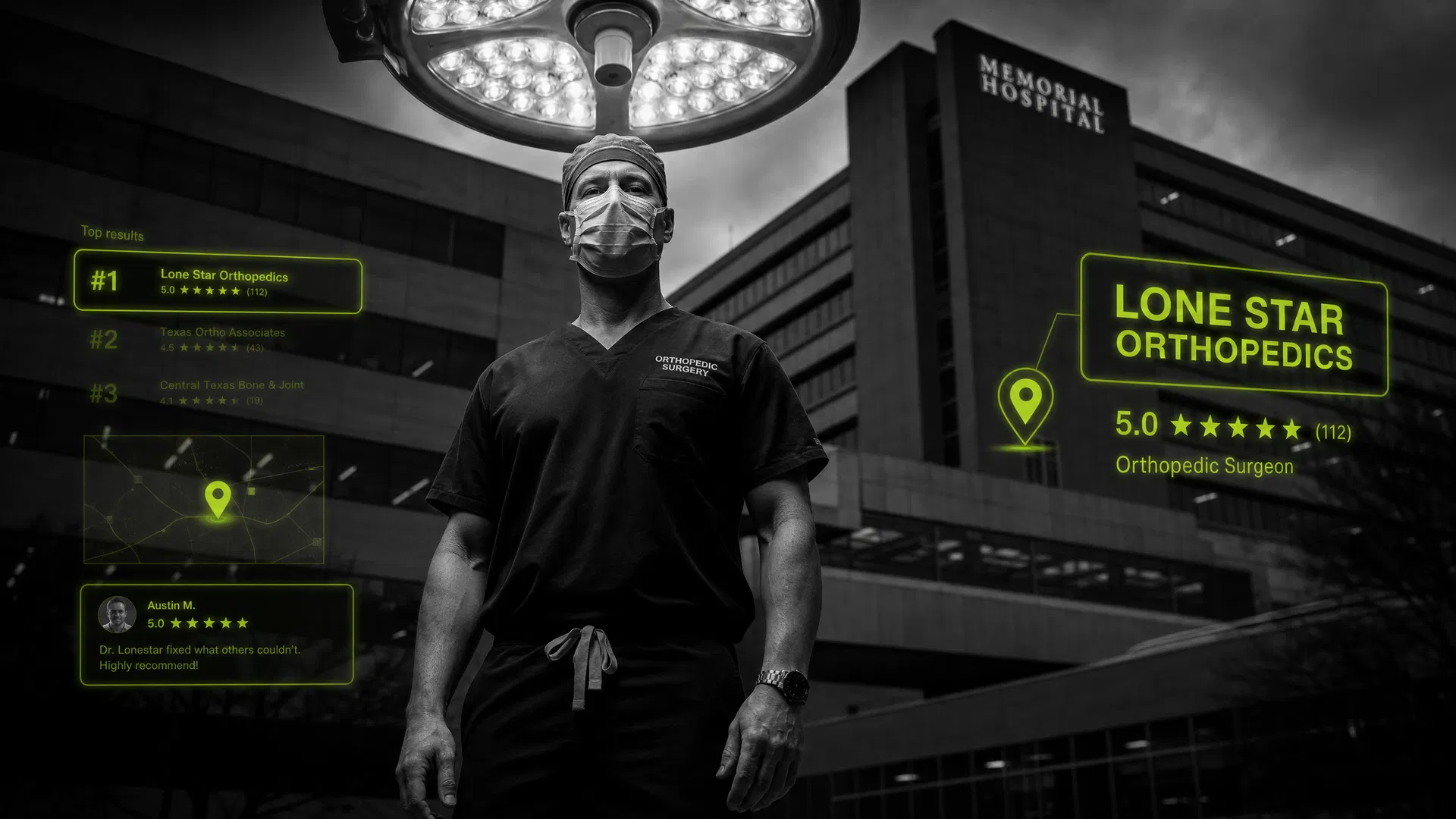
The Pressure to Consolidate
The landscape of orthopedic surgery is shifting rapidly. Across the country, independent practices are facing unprecedented pressure to consolidate, merge, or sell to massive hospital systems and private equity firms.
The pressure does not just come from administrative burdens or declining reimbursement rates; it comes from patient acquisition. Hospital systems deploy massive, multi-million-dollar marketing budgets to dominate local search results, blanket the community with billboards, and control the referral networks.
"Hospitals are massive. They have a massive budget," our founder at Lush Digital explains. "Usually they're getting more clicks, and when you're an independent surgeon, it can feel overwhelming. The pressure to consolidate is overwhelming... If you try to compete with them pound for pound on budget, you're going to lose."
When an independent surgeon cannot generate their own patient demand, they become reliant on the hospital system for survival. They lose their autonomy, their clinical independence, and their ability to control their own schedule.
The Trap of Institutional Employment
Many surgeons who succumb to this pressure soon realize they have traded one set of problems for another. They gain administrative relief, but they lose the very thing that drove them to medicine in the first place: the ability to practice medicine on their own terms.
"Physicians often feel trapped," observes Dr. Adam Anz, a prominent independent orthopedic surgeon. "And they work really hard to get training. To pursue their dream, and they get into practice, and they find that it's not what they wanted. And they don't know how to make it what they want."
Inside a massive healthcare bureaucracy, the surgeon becomes a cog in a machine. They are told how many patients to see per hour, what procedures to prioritize, and how to practice. Their personal brand is subsumed by the hospital's generic corporate identity. They are no longer Dr. Smith, the elite sports medicine specialist; they are simply an employee of Mega-Health System.
The hospital has a massive budget — but it cannot be nimble, reactive, or personal. That asymmetry is your greatest weapon.
The Gap in the Market
Despite this overwhelming pressure, there is a path forward for the fiercely independent surgeon. The hospital systems, for all their massive budgets, have significant vulnerabilities.
"Hospitals are typically very rigid in what they will do," our founder notes. "They have stiff brands, they are not very adventurous. They do not think outside the box. And so I think you should look for asymmetric opportunities. There are things that hospitals cannot be nimble, cannot be flexible, cannot be reactive in. And those are the areas you should look to maximize and exploit."
The problem is that most independent surgeons do not have the tools or the expertise to exploit these vulnerabilities. They are clinicians, not digital marketers. And when they look for help, they find a landscape dominated by generic healthcare marketing agencies that treat them like just another account.
"The hospitals and the bigger fish are real protective and don't give any opportunities, but this seems like a gap," Dr. Anz points out. "What is available to help physicians?"
Building Digital Autonomy
The answer to that gap is Digital Autonomy. Digital Autonomy is the ability to generate your own patient demand, independent of hospital referral networks or institutional marketing budgets. It is the power to control your own digital footprint, your own reputation, and your own patient acquisition pipeline.
"We need to empower physicians to still pursue their dream, and to do it through marketing in a tasteful way," Dr. Anz emphasizes. "If we can empower physicians to have the ability to still pursue their dreams regardless of the power of hospitals and insurance companies... I'd love to be involved."
Building Digital Autonomy requires a fundamental shift in how you view your practice's digital presence. It is not an expense; it is the most critical infrastructure investment you will make.
Here is how independent orthopedic surgeons build Digital Autonomy:
1. Own Your Digital Real Estate
Stop renting space on third-party directories like Healthgrades or Zocdoc. Stop relying on the hospital's bio page to tell your story. You must own your own high-performance website — your Digital Empire. This is the central hub of your digital autonomy, the one asset you completely control.
2. Dominate the Local Pack
Hospital systems are notoriously bad at managing individual Google Business Profiles. They treat them as administrative afterthoughts. You must treat your GMB profile as a high-performance conversion engine. By deploying granular categorization, aggressive review generation, and continuous post management, you can consistently outrank the hospital in the Local Pack.
3. Build Deep Topical Authority
Hospitals optimize for broad, generic terms. You must optimize for deep, specific procedures. Build comprehensive content silos around the exact surgeries you want to perform. When a patient searches for a highly specific, complex procedure, your deep content will outrank the hospital's superficial directory page every time.
The Three Pillars of Digital Autonomy
Building true digital autonomy is not a single action; it is a system. Independent orthopedic surgeons who successfully break free from institutional dependence do so by investing in three interconnected pillars simultaneously.
Pillar One: Search Dominance. Your practice must rank prominently in Google's organic results and Local Pack for the procedures you perform and the patients you want to attract. This requires deep, authoritative content, advanced technical SEO, and an aggressive Google Business Profile strategy. Search dominance creates a predictable, measurable flow of inbound patient demand that is entirely independent of any hospital referral network.
Pillar Two: Reputation Authority. In orthopedic surgery, trust is the ultimate currency. Patients making complex surgical decisions research their surgeons extensively. They read reviews, study credentials, and evaluate outcomes. Your digital reputation must reflect the caliber of your surgical skills. This means systematically generating 5-star reviews from patients who have successfully returned to the game of life, building a physician profile that communicates genuine expertise, and ensuring your online presence tells the story you want told.
Pillar Three: Brand Independence. Your personal brand must be distinct from any institution you are affiliated with. When patients search your name, they must find a compelling, authoritative digital presence that belongs entirely to you. This brand independence is what protects you during transitions — whether you are leaving a hospital system, joining a new group, or building toward a practice sale. The brand travels with you because you own it.
Digital Autonomy is not a marketing expense. It is the most important infrastructure investment an independent surgeon will ever make.
The Long-Term Return on Digital Autonomy
The investment in digital autonomy compounds over time in ways that traditional advertising never can. A billboard delivers impressions for as long as you pay for it, then disappears. A well-built content silo, a dominant Google Business Profile, and a 500-review reputation continue to generate patient demand for years, with diminishing marginal cost.
Surgeons who invest in their digital infrastructure in year one of their independent practice are in a fundamentally different competitive position in year five than those who waited. The content they published early is now ranking for dozens of long-tail keywords. The reviews they generated are now a towering competitive moat. The brand they built is now recognized across their market.
This is the compounding return on digital autonomy. It is not a marketing expense; it is the most important infrastructure investment an independent surgeon can make.
Reversing the Pressure
When you build Digital Autonomy, the dynamic shifts entirely. You are no longer reliant on the hospital for survival; you become an independent force in your market.
"By owning your own digital presence... you can reverse the pressure," our founder explains. "You are producing more leads than the hospital... You're more reactive. You're more aggressive. You're more nimble in the space, and so you can do better than the hospital. You can de-seat and dethrone them, and I've seen this happen where independent surgeons go from a position of 'I need them to survive' to a position of 'they need me.'"
This is the ultimate goal of independent orthopedic marketing. It is not just about getting more clicks or ranking higher on Google. It is about empowering surgeons to stay in the game, to control their own destiny, and to build the practice they always dreamed of. The surgeons who build digital autonomy today are the ones who will still be practicing on their own terms in ten years — seeing the patients they want, performing the surgeries they love, and building the legacy they trained for.
[Schedule Your Digital Empire Architecture Session with Lush Digital Today]